
Green hydrogen is rapidly emerging as a cornerstone of the global energy transition. Produced using renewable energy sources, it offers a clean alternative to fossil fuels across industries like steel, fertilizers, mobility, and power storage.
But how exactly is green hydrogen produced? What technologies are involved? And which approach is the most efficient and cost-effective?
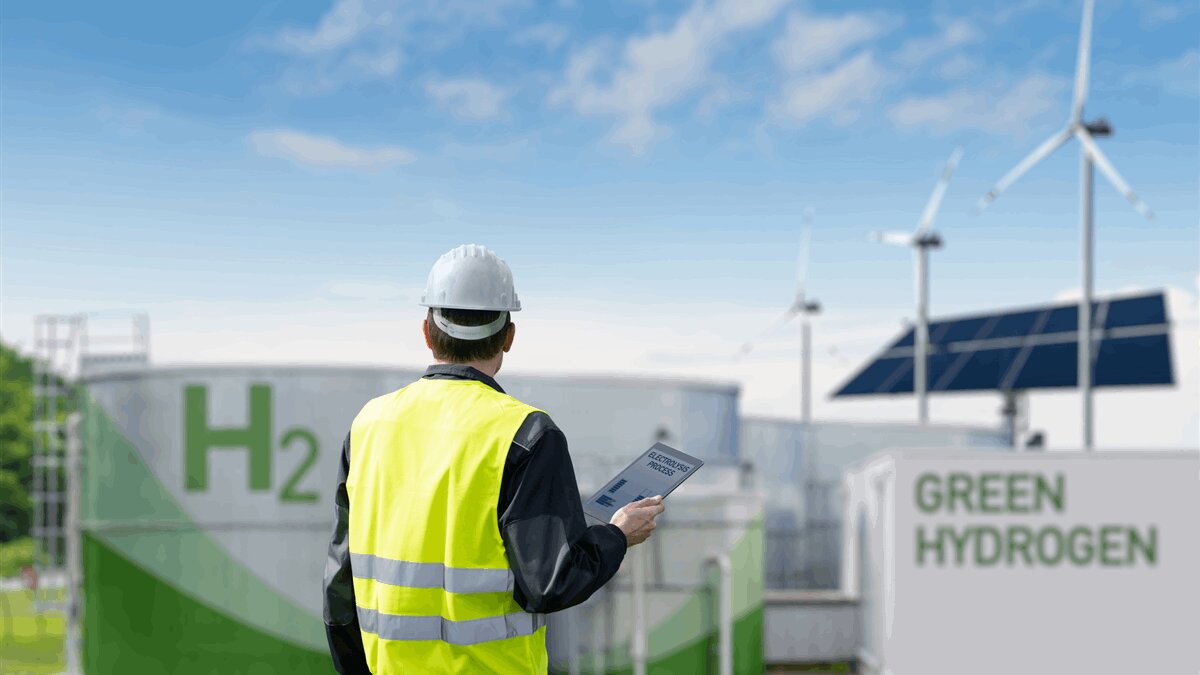
This guide breaks down everything you need to know — from core science to future innovations including efficiency and costs of each technology.
What is green hydrogen?
Green hydrogen is hydrogen produced through water electrolysis powered by one or many renewable energy such as solar or wind. Unlike grey or blue hydrogen, it generates zero carbon emissions during production.
How electrolysis works?
Simple explanation:
Electrolysis is the process of using electricity to split water (H₂O) into:
- Hydrogen (H₂)
- Oxygen (O₂)
Think of it as reversing combustion — instead of burning hydrogen to make water, you break water to get hydrogen.
Technical Breakdown:
Electrolysis occurs in an electrolyzer, which consists of:
- Anode (positive electrode) → Oxygen evolution.
- Cathode (negative electrode) → Hydrogen evolution.
- Electrolyte → Medium that allows ion transfer.
Reactions:
- Anode (oxidation): 2H₂O → O₂ + 4H⁺ + 4e⁻
- Cathode (reduction): 4H⁺ + 4e⁻ → 2H₂
- Overall reaction: 2H₂O → 2H₂ + O₂
Types of electrolyzers.
1. Alkaline electrolyzers (AEL).
How it works?
Uses a liquid alkaline solution (KOH or NaOH) as electrolyte.
Key features:
- Mature and proven technology.
- Lower cost.
- Uses non-precious metals (nickel-based catalysts).
Pros:
- Long lifespan.
- Low CAPEX.
- Established supply chain.
Cons:
- Slower response to fluctuating renewable energy.
- Lower current density.
2. PEM (Proton Exchange Membrane) electrolyzers.
How it works?
Uses a solid polymer membrane that conducts protons.
Key features:
- Compact design.
- High efficiency.
- Fast response time.
Pros:
- Ideal for solar/wind integration.
- High purity hydrogen.
- Higher current density.
Cons:
- Higher cost (uses platinum/iridium).
- Shorter lifespan than alkaline (in some cases).
3. SOEC (Solid Oxide Electrolyzers Cell).
How it works?
Operates at high temperatures (700–1000°C) using a ceramic electrolyte.
Key features:
- Uses heat + electricity.
- Very high efficiency potential.
Pros:
- Highest theoretical efficiency.
- Can utilize industrial waste heat.
Cons:
- Still in early commercialization stage.
- Material durability challenges.
- High operational complexity.
Efficiency comparison:
| Technology | Efficiency Range | Key Insight |
|---|---|---|
| Alkaline | 60–70% | Reliable but less flexible. |
| Proton Exchange Membrane | 65–75% | Best for renewables. |
| Solid Oxide | 75–85% | Future potential leader. |
Insight: Efficiency improves when heat integration is used (SOEC), but flexibility favors PEM.
Cost breakdown: CAPEX vs OPEX.
CAPEX (Capital expenditure):
Includes:
- Electrolyzer system.
- Power electronics.
- Installation.
| Technology | CAPEX Trend |
|---|---|
| Alkaline | Lowest. |
| PEM | Medium–High. |
| SOEC | High (early stage). |
OPEX (Operational expenditure):
Includes:
- Electricity (70–80% of total cost).
- Maintenance.
- Water treatment.
Critical Insight: Electricity cost dominates hydrogen production economics.
Cost of producing 1 kg of green hydrogen.
- Current range: $3 – $7 per kg.
- Target (2030): $1 – $2 per kg.
Cost depends on:
- Renewable electricity price.
- Electrolyzer efficiency.
- Capacity utilization.
Role of renewable energy (solar + wind coupling).
Green hydrogen becomes viable only when paired with cheap renewable power.
Solar + Electrolysis:
- Best for daytime operations
- Works well in high irradiation regions (like India)
Wind + Electrolysis:
- Better for continuous generation
- Higher capacity factor
Solar + Wind (hybrid systems):
- Smooth energy supply.
- Improves electrolyzer utilization.
Key Challenge: Renewables are intermittent — electrolyzers must handle fluctuating input efficiently, otherwise efficiency drop by high margin.
Water requirements & challenges.
How much water is needed?
- ~9 liters of water → 1 kg hydrogen (theoretical).
- Real-world usage: 10–15 liters per kg.
Key challenges.
1. Water purity:
Electrolyzers require deionized water, not raw water.
2. Water scarcity:
Large-scale hydrogen plants may stress local water resources.
3. Treatment cost:
Desalination and purification add to OPEX.
Can seawater be used?
Yes, but not directly.
Challenges:
- Corrosion.
- Chlorine formation.
- Catalyst degradation.
Solution:
- Desalination + purification.
- Emerging direct seawater electrolysis (experimental).
Future innovations in green hydrogen.
1. AEM (Anion Exchange Membrane) electrolyzers.
- Combines benefits of alkaline + PEM
- Uses cheaper materials
- Still under development
2. Hybrid electrolysis systems.
- Combine multiple technologies.
- Optimize efficiency + flexibility.
3. High-pressure electrolysis.
- Produces compressed hydrogen directly.
- Reduces storage cost.
4. AI + smart optimization.
- Predictive load balancing.
- Efficiency optimization with renewables.
5. Integrated energy systems.
- Hydrogen + battery + grid hybrid models.
- Improves overall system economics.
Key takeaways.
- Electrolysis is the backbone of green hydrogen production.
- PEM dominates renewable integration, while alkaline leads in cost.
- Electricity cost is the biggest factor in hydrogen pricing.
- Water availability and purity are critical constraints.
- Emerging technologies like AEM and SOEC could redefine the industry.

Leave a Reply