
Let’s play a quick game. Your landlord just texted asking for last year’s rental agreement “in the next ten minutes.” Go.
If your stomach just did a little flip, congratulations — you’re a member of the world’s largest support group: people whose filing system is a folder literally named “Untitled” that contains 4,000 files and a single, aging sense of dread.
Here’s the good news.
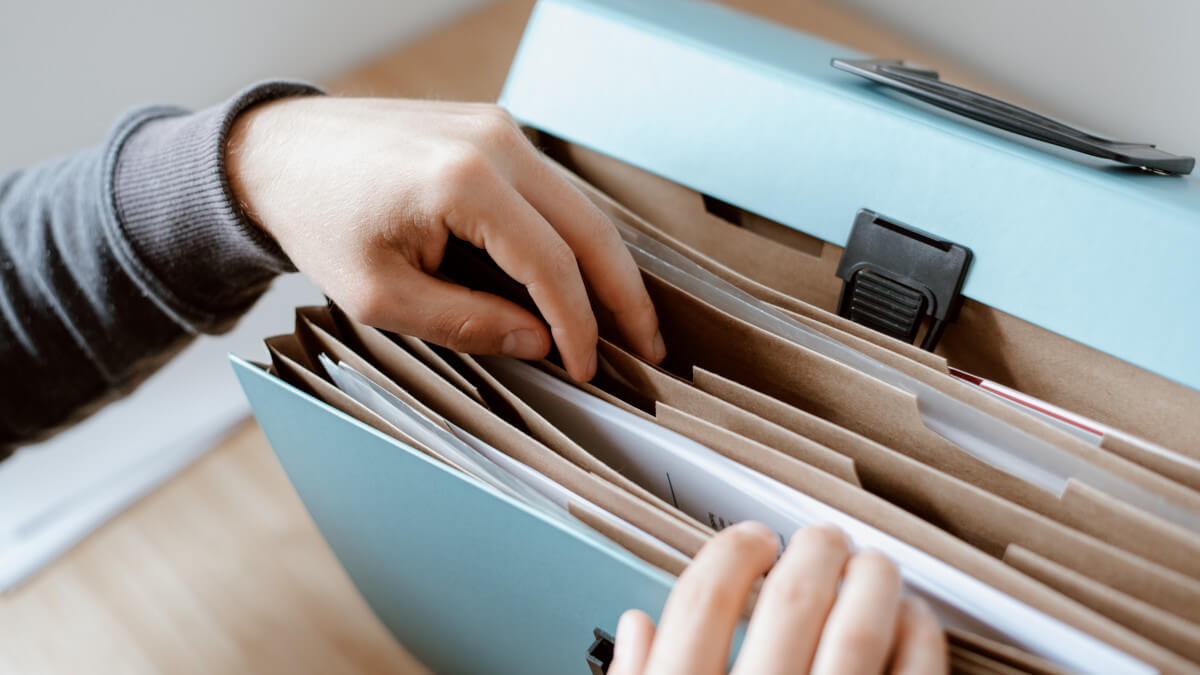
You don’t need to become a filing robot with a label-maker fetish to fix this. You just need a system that works while you’re busy living your actual life. Let’s get into it.
The real cost of “I know it’s here somewhere”, and its bad.
We treat document-hunting like a minor inconvenience, but it’s really a tiny recurring tax on your sanity. Five minutes here, ten minutes there, one existential crisis during tax season — it adds up.
And it always seems to strike at the worst possible moment: a client meeting starting in ninety seconds, a flight boarding in ten minutes, a visa appointment where the officer is very much not interested in your creative interpretation of “supporting documents.” The universe has a cruel sense of timing, and your Downloads folder is its favorite prop.
The goal isn’t perfection. The goal is simple: never waste time searching for important documents again — because future-you deserves better than digging through seventeen folders called “New Folder (3).”
Step 1: Accept that “I’ll remember where I put it” is a big lie.
We’ve all said it. We’ve all been wrong. Human memory is a beautiful, unreliable thing — great for remembering song lyrics from 2009, terrible for remembering which of your six devices has the scanned copy of your passport.
The fix isn’t a better memory. It’s a system that doesn’t need one.
Step 2: Build folders like you’re talking to future-you.
Future-you is stressed, in a hurry, and has zero patience for cleverness. So skip the overly artistic folder names (“Life Stuff,” “Misc,” “That One Thing”) and go for painfully obvious categories instead:
- Identity — ID cards, passport, licenses.
- Finance — bank statements, tax filings, investment papers.
- Property — rent agreements, ownership papers, utility bills.
- Work — contracts, offer letters, appraisals.
- Health — insurance, prescriptions, reports.
- Travel — bookings, visas, itineraries.
This is one of the genuinely simple ways to organize your documents — not clever, not fancy, just obvious enough that even sleep-deprived-3AM-you can find things without a search party.
Step 3: One home, not five.
Here’s the sneaky villain of document chaos: duplication. A copy on your laptop, another in an old email, a third one someone sent on WhatsApp four years ago, and a fourth living a mysterious life in a folder called “backup_backup_FINAL”, this loop never ends.
Pick one central place — cloud storage works beautifully — and make it the single source of truth. Everything else is just noise pretending to be useful.
This is genuinely how to keep important documents ready when you need them: not by having copies everywhere, but by always knowing exactly where the real one lives.
Step 4: Name files like you actually want to find them again.
“Scan001.pdf” is not a name. It’s a cry for help.
Instead, go for something searchable and dated:
2024_RentAgreement_Signed.pdf2025_TaxReturn_Final.pdfPassport_Copy_2026.pdf
Boring? Yes. Life-changing at 11:58 PM before a deadline? Also yes.
Step 5: Scan everything, even the annoying paper stuff.
Paper documents are basically ancient scrolls at this point — fragile, easy to misplace, and somehow always needed the one week you moved houses.
Scan the important ones. Store the digital version properly. Keep the physical copy safely tucked away, but stop relying on it as your primary system. This single habit is how you finally stop hunting for files in that one drawer that’s 60% receipts and 40% mystery.
Step 6: Do a 10-minute monthly cleanup.
Not a full weekend reorganization — just a quick tidy-up. Delete duplicates, rename anything vague, move stray files into their proper folder. Think of it as flossing for your digital life: unglamorous, easy to skip, but everyone can tell when you don’t do it.
This tiny habit is what helps you avoid last-minute document searches before meetings, travel, and deadlines — because chaos doesn’t build up overnight, it builds up one ignored file at a time.
The payoff.
Imagine this instead: your landlord texts, and you’re already attaching the PDF before you’ve finished reading the message. Your flight’s boarding, and your ticket and ID are one tap away. Your boss asks for last quarter’s report, and you find it faster than you can say “let me check.” That’s not a fantasy. That’s just what happens when your documents have a home instead of a rumor of a home.
Why you’ll want to bookmark this?
A few honest reasons to keep this page around:
- You will need this again. Not because you’re disorganized — because life keeps generating documents, and entropy is undefeated.
- It’s a five-minute read that saves you hours. Rare trade in this economy.
- It works for literally everyone — freelancers, students, parents, people who still have a “Taxes 2019” folder they’re scared to open.
- Your future self will send you a mental thank-you note every time they find a document in three seconds instead of thirty stressful minutes.
- It’s genuinely more fun to reread than most productivity advice, and hey, we said what we said.
So go ahead, bookmark it, forward it to the friend whose desktop looks like a crime scene, and enjoy never panicking over a missing PDF again.

Leave a Reply