
Artificial Intelligence (AI) is one of the most powerful and transformative technologies of the modern technology world. Since launch it has disrupted every single fields.
From the smartphones in our pockets to advanced medical systems in hospitals, AI is shaping how we live, work, communicate, and make decisions.
- But what exactly is Artificial Intelligence?
- Is it robots? Is it ChatGPT? Is it something dangerous?
- Or is it simply advanced software?
This complete guide will explain AI from the ground up — in simple language, but with deep clarity. By the end of this article, you will understand:
- What Artificial Intelligence really is
- How AI works step by step
- Types of AI
- AI vs Machine Learning vs Deep Learning
- Real-world uses of AI
- How AI impacts jobs and businesses
- Risks and ethical concerns
- The future of AI
Let’s begin.
What is Artificial Intelligence?
Artificial Intelligence refers to the ability of machines or computer systems to perform tasks that normally require human intelligence.

Human intelligence includes abilities such as:
- Learning from experience.
- Understanding language.
- Recognizing images and sounds.
- Solving problems.
- Making decisions.
- Adapting to new situations.
When machines are designed to simulate these abilities, we call it Artificial Intelligence.
In simple terms:
AI is the science of making machines smart.
However, it is important to understand that AI does not mean machines are conscious or emotional. AI systems operate based on mathematics, algorithms, and data — not feelings.
Why AI Was Created!
Computers were originally built to follow strict instructions. They could calculate fast, store information, and execute commands, but they could not “learn” or “adapt.”
As data increased massively in the digital age, traditional programming became insufficient. Humans could not manually program solutions for every possible scenario.
For example:
- How do you program a system to recognize every face in the world?
- How do you manually teach a computer every possible sentence in English?
- How do you program a fraud detection system to catch new types of scams?
Instead of hardcoding rules, scientists developed systems that learn patterns from data.
This shift led to Artificial Intelligence.
How Artificial Intelligence Works (Step-by-Step).
AI works through a structured process. It is not magic — it follows logical stages.
Step 1: Data Collection.
AI systems require large amounts of data. This data can include:
- Text (books, websites, messages).
- Images (photos, medical scans).
- Audio (voice recordings).
- Numbers (financial transactions).
- User behavior (clicks, searches).
Data is the foundation of AI. Without data, AI cannot learn.
Step 2: Data Processing.
Raw data is messy. It must be cleaned and structured.
For example:
- Removing duplicate entries.
- Correcting errors.
- Formatting data properly.
- Labeling images (e.g., “cat,” “dog,” “car”).
Clean data improves AI accuracy.
Step 3: Training the Model.
This is where Machine Learning comes in.
The AI system uses algorithms to identify patterns in data. It creates mathematical relationships between inputs and outputs.
For example:
- If input = email content.
- Output = spam or not spam.
The model adjusts itself repeatedly to reduce errors.
This training process may require:
- Millions or billions of data examples.
- High computing power.
- Advanced mathematical optimization.
Step 4: Testing and Validation.
After training, the AI model is tested on new data it has never seen before.
If it performs accurately, it is ready for real-world use.
Step 5: Deployment.
The AI model is integrated into real applications:
- Chatbots.
- Fraud detection systems.
- Recommendation engines.
- Autonomous systems.
Step 6: Continuous Learning.
Modern AI systems can improve over time as they receive more data.
Types of Artificial Intelligence.
AI can be categorized based on capability.
1. Narrow AI (Weak AI).
This is the only type of AI that exists today. Narrow AI is designed to perform one specific task extremely well. It is still in improvement phase.
Examples:
- ChatGPT answering questions.
- Google Maps calculating routes.
- Netflix recommending movies.
- Face recognition on smartphones.
Narrow AI cannot perform tasks outside its training.
2. Artificial General Intelligence (AGI).
AGI refers to a system that can understand, learn, and apply intelligence across a wide range of tasks — like a human. This type of AI does not yet exist.
Researchers are working toward it, but it remains theoretical.
3. Artificial Super Intelligence (ASI).
This would surpass human intelligence in all areas. It is purely speculative and not currently achievable with current resources and technology.
Artificial Intelligence (AI) vs Machine Learning (ML) vs Deep Learning (DL).
These terms are often confused.
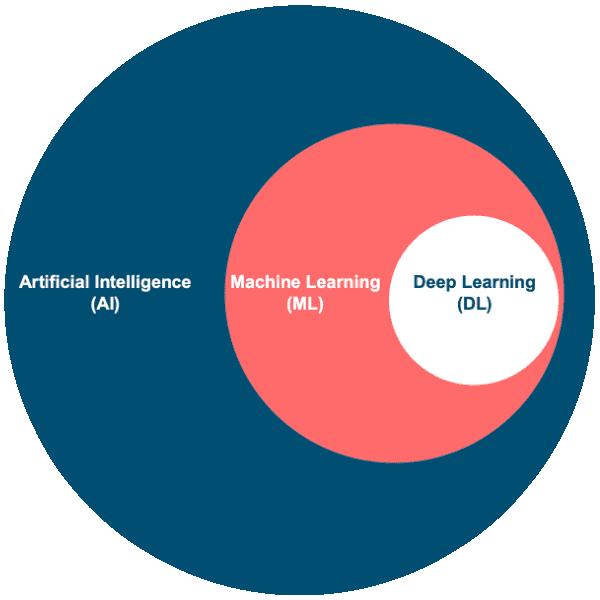
Artificial Intelligence (AI):
The broad concept of machines performing intelligent tasks.
Machine Learning (ML):
A subset of AI that allows systems to learn from data instead of being explicitly programmed.
Deep Learning (DL):
A specialized branch of Machine Learning using neural networks with multiple layers.
Think of it like this:
- AI → Big Field.
- Machine Learning → Subfield.
- Deep Learning → Advanced method within ML.
What Are Neural Networks?
Neural networks are inspired by the human brain. The human brain has neurons that process and transmit signals. Similarly, artificial neural networks consist of layers:
- Input layer.
- Hidden layers.
- Output layer.
Each layer processes information and passes it forward.
Deep learning models use many hidden layers — hence the term “deep”.
Neural networks power:
- Image recognition.
- Speech recognition.
- Language models.
- Self-driving systems.
Real-World Applications of AI.
AI is already deeply integrated into everyday life.
1. Search Engines.
When you search on Google, AI ranks results based on relevance.
2. Recommendation Systems.
Amazon, YouTube, Netflix suggest content based on your behavior.
3. Virtual Assistants.
Siri, Alexa, Google Assistant use natural language processing.
4. Healthcare.
AI helps detect diseases from scans, predict patient risks, and assist diagnosis.
5. Finance.
AI detects fraud, manages trading systems, and assesses risk.
6. Business Automation.
AI automates customer service, marketing campaigns, and data analysis.
7. Transportation.
AI powers navigation systems and assists in autonomous driving research.
Benefits of Artificial Intelligence.
AI provides multiple advantages:
Increased Efficiency:
Machines work 24/7 without fatigue.
Accuracy:
AI reduces human errors in repetitive tasks.
Automation:
Routine tasks can be automated, saving time.
Data Analysis:
AI can analyze massive datasets quickly.
Personalization:
Content, ads, and services become more tailored.
Risks and Challenges of AI.
AI also raises serious concerns.
Job Displacement:
Automation may replace repetitive roles.
Bias:
AI can inherit bias from training data.
Privacy Issues:
Large-scale data collection raises ethical questions.
Security Risks:
AI can be misused for deepfakes or cyber attacks.
Overdependence:
Excessive reliance on AI may reduce human critical thinking.
Responsible AI development is crucial.
Is AI Replacing Humans?
AI is not replacing humans entirely.
Instead, it is:
- Replacing repetitive tasks.
- Enhancing human productivity.
- Creating new types of jobs.
Historically, technology creates new opportunities even as it changes existing roles.
The future is likely collaborative: Humans + AI working together.
AI in Business and Careers.
Businesses use AI for:
- Customer support automation.
- Predictive analytics.
- Marketing optimization.
- Fraud detection.
- Inventory management.
Career opportunities include:
- AI engineer.
- Data scientist.
- Machine learning engineer.
- AI researcher.
- Prompt engineer.
- AI ethics specialist.
Learning AI fundamentals can provide career advantages.
The Future of Artificial Intelligence.
AI development is accelerating.
Future possibilities include:
- More advanced language models.
- Improved robotics.
- Smarter healthcare systems.
- Enhanced education personalization.
- AI-assisted scientific research.
However, ethical regulation and governance will become increasingly important.
Should You Learn AI?
Understanding AI is becoming essential because:
- It impacts nearly every industry.
- It changes how businesses operate.
- It affects job markets.
- It shapes digital tools.
Even if you are not a programmer, learning AI basics helps you stay informed and competitive. As the industry is new we all can master it in short time.
Final Conclusion.
Artificial Intelligence is not a mysterious robot takeover.
It is a powerful technology built on:
- Data.
- Algorithms.
- Mathematical models.
- Continuous learning.
Currently, AI is narrow and task-specific.
It assists humans rather than replacing them entirely. As AI evolves, understanding its fundamentals becomes more important than ever.
The future belongs not to AI alone — but to those who understand it and knows how to use it effectively in day to day work life.
