
Imagine telling an assistant, “Plan my three-day trip to Goa under ₹30,000, book the cheapest flights, and add everything to my calendar.” Then imagine walking away while it researches, compares options, books tickets, and sends you a confirmation.
That is the promise of AI agents.
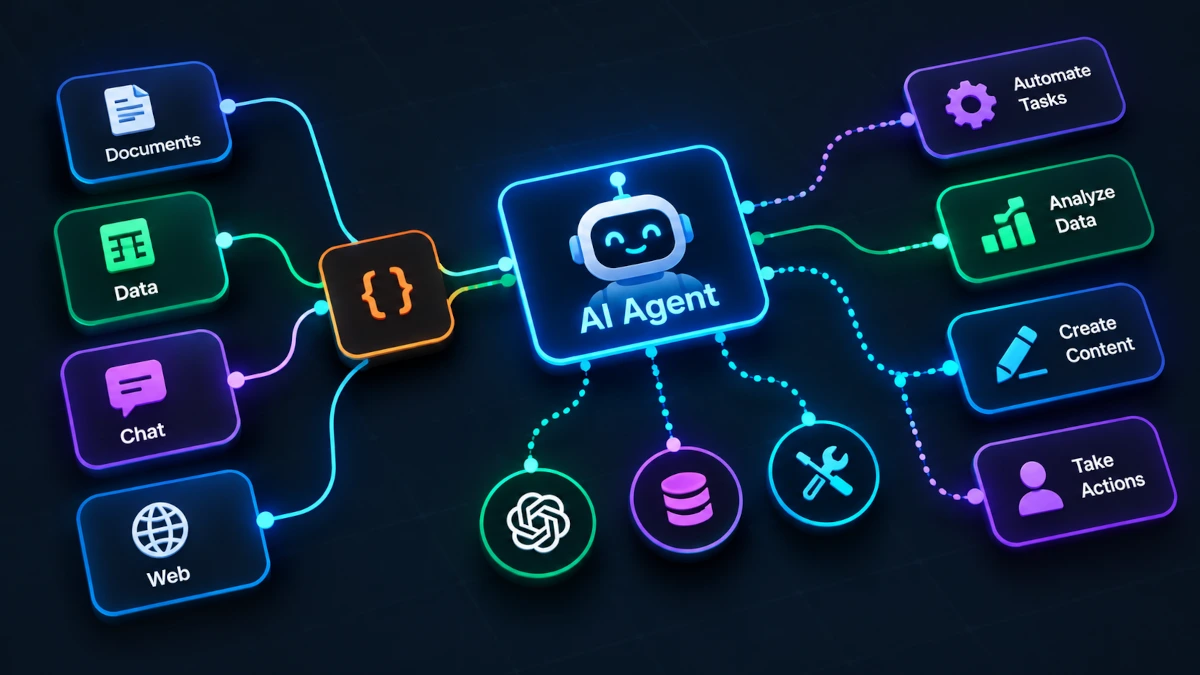
This guide explains what AI agents are, how they work, where they’re used in real life, and what risks and limits you should watch out for.
What is an AI agent?
An AI agent is a software system that can understand a goal, decide what steps are needed, use tools to carry them out, and adjust along the way, with little or no human guidance at each step.
Most AI tools you’ve used answer one question at a time. An agent is built to get things done. You give it an objective, and it works out how to reach it.
A simple way to remember it:
A chatbot talks. An agent acts.
AI Agent vs. Chatbot vs. Generative AI.
These terms are often mixed up, so here is how they differ.
| AI Agent | Chatbot / Generative AI | |
|---|---|---|
| Main job | Pursues a goal. | Responds to a prompt. |
| Steps | Plans and carries out multiple steps. | Usually one reply per prompt. |
| Tools | Uses search, apps, code, databases, APIs. | Often none. |
| Autonomy | Can work independently within limits. | Waits for you at every turn. |
| Example | Find three flats under my budget, email the landlords, and schedule viewings. | Write an email to my landlord. |
Generative AI, such as a large language model (LLM), often serves as the “brain” of a modern agent. The agent adds the ability to plan, remember, and act.
How do AI agents work?
Most agents follow a loop that repeats until the goal is met:
- Perceive: The agent takes in information such as your request, a document, a web page, or data from an app.
- Reason and plan: It breaks the goal into smaller steps and decides what to do first.
- Act: It uses a tool, such as running a search, writing code, sending an email, or updating a spreadsheet.
- Observe: It checks the result. Did it work? Is there new information?
- Adapt: If something failed or changed, it revises the plan and tries again.
This is how an agent handles problems that need many steps and surprises along the way.
The building blocks of an AI agent.
Most modern agents combine four parts:
1. The brain (the AI model):
Usually a large language model. It understands instructions, reasons through problems, and decides what to do next.
2. Tools:
Tools are what let an agent affect the real world. They can include:
- Web search
- A code interpreter
- Email and calendar access
- Databases and company software
- Other apps through APIs (connections that let software talk to software)
Without tools, an AI can only talk. With them, it can act.
3. Memory:
- Short-term memory holds the current task, so the agent knows what it has already done.
- Long-term memory stores information across sessions, such as your preferences or past results.
4. Planning:
The agent breaks a big goal into smaller tasks and puts them in a sensible order. Good planning is a big part of what makes an agent useful.
Types of AI agents.
AI researchers have long grouped agents by how they make decisions. These categories come from classic AI textbooks and still help.
- Simple reflex agents react to the current situation using fixed rules. A thermostat that turns on heating when the room is cold is one.
- Model-based agents keep an internal picture of the world, so they can act sensibly even with incomplete information.
- Goal-based agents choose actions by asking, “Will this move me closer to my goal?”
- Utility-based agents weigh trade-offs to pick the best outcome, not just any that works, such as balancing price, time, and comfort.
- Learning agents improve with experience, getting better at their task over time.
Today’s LLM-powered agents often blend several of these traits.
Real-world examples of AI agents.
AI agents are already in use across many fields:
- Customer support: Agents can look up an order, process a refund, and update the customer’s record, handing the case to a human when it’s complicated.
- Software development: Coding agents can read a codebase, write changes, run tests, fix errors, and propose the finished work for review.
- Research and analysis: Agents can gather information from many sources, compare it, and prepare a summary report.
- Sales and marketing: They can qualify leads, draft personalised outreach, and update CRM systems.
- Personal productivity: They can manage schedules, organise email, and handle routine bookings.
- Finance and operations: They can reconcile records, flag unusual transactions, and automate routine reporting.
- Self-driving and robotics: Physical agents sense their surroundings and make decisions in real time.
Single agents and multi-agent systems.
Some tasks are handled by one agent. Others work better with a team of agents, each with a specialty. In a content workflow, for example, one agent might research a topic, a second draft the piece, and a third check facts and polish the language. A coordinating agent can manage the hand-offs.
Frameworks such as LangChain/LangGraph, Microsoft’s AutoGen, and CrewAI are popular tools that developers use to build these systems. Standards such as the Model Context Protocol (MCP), introduced by Anthropic in late 2024, aim to give agents a common way to connect to tools and data sources.
Benefits of AI agents.
- Time savings: Repetitive, multi-step work can run in the background.
- Consistency: Agents follow the same process every time and don’t get tired.
- Availability: They can work around the clock.
- Scalability: One well-designed agent setup can handle many tasks at once.
- Focus for humans: People can spend more time on creative, strategic, and relationship-based work.
Challenges and risks you should know about.
AI agents are powerful, but they are not perfect. A responsible overview should include the limits:
- Mistakes and “hallucinations”: AI models can state incorrect information confidently. When an agent acts on a wrong assumption, the error can carry through several steps.
- Security risks: Agents that read emails, web pages, or documents can be tricked by hidden instructions planted in that content, an attack known as prompt injection.
- Over-permissioning: An agent with broad access to your accounts could do real damage if it misbehaves. Giving agents only the access they need is a core safety practice.
- Lack of transparency: It isn’t always easy to see why an agent made a particular decision.
- Cost: Multi-step agent work can use a lot of computing resources.
- Accountability: When an agent makes a mistake, it can be unclear who is responsible. Businesses need clear policies.
Keep a human in the loop for high-stakes actions such as payments, deleting data, or sending sensitive messages. Let the agent propose, and let a person approve.
How to get started with AI agents?
If you’re curious, here is a sensible path:
- Start small. Pick one repetitive task, like summarising reports or sorting emails.
- Use trusted tools. Try the agent features in well-known AI products before building anything custom. Don’t rush into tools that are free for consuming your data.
- Limit access. Give the agent only the permissions it needs.
- Review its work. Check outputs early on to learn where it’s reliable and where it isn’t. Set various instructions and rules to control the desired outcome.
- Expand gradually. Add complexity as your confidence grows.
The future of AI agents.
AI agents are improving quickly. They are getting better at long, complex tasks, working with more tools, and collaborating with other agents. Many people expect them to become a standard part of how we work, much like spreadsheets or email, handling routine tasks while people set the direction and make the final calls.
The most likely future isn’t agents replacing people. It’s people working alongside agents, with humans staying in charge.
Frequently Asked Questions.
Is ChatGPT or Claude an AI agent? Chat assistants are primarily conversational. When they are given tools and the ability to plan and carry out multi-step tasks, they can act as agents. AI agenets take a broad goal, plan the steps, use external tools or software, and complete a workflow independently without needing constant human guidance.
Are AI agents the same as robots? No. Most AI agents are software only. Robots are physical machines, and some are controlled by AI agents.
Do I need to know coding to use an AI agent? Not necessarily. Many products now offer agent features through simple chat interfaces. Building custom agents usually requires some technical skill, though no-code tools are growing.
Are AI agents safe? They can be, when used with sensible limits: restricted permissions, human approval for important actions, and regular review.
Will AI agents take my job? They are likely to change many jobs by automating routine tasks. People who learn to work effectively with agents are well placed to benefit.
Final thoughts.
An AI agent is more than a smarter chatbot. It’s a system that can understand a goal, make a plan, use tools, and get work done. Used wisely, with clear boundaries and human oversight, agents can free up time and make complex work easier. The best way to understand them is to try one on a small, low-risk task and see what it can do.

Leave a Reply