
Here’s a fact that surprises almost everyone the first time they hear it: when you send an email from Mumbai to New York, video call a friend in London, or stream something from a server in Singapore, that data almost certainly isn’t traveling through satellites.
It’s traveling through cables — physical, hair-thin fiber optic cables — lying on the floor of the ocean.
Yes, the internet, that mysterious cloud-shaped thing we imagine floating somewhere above us, actually runs through wires at the bottom of the sea.
Around 95–99% of international data traffic moves through submarine cables, not satellites.
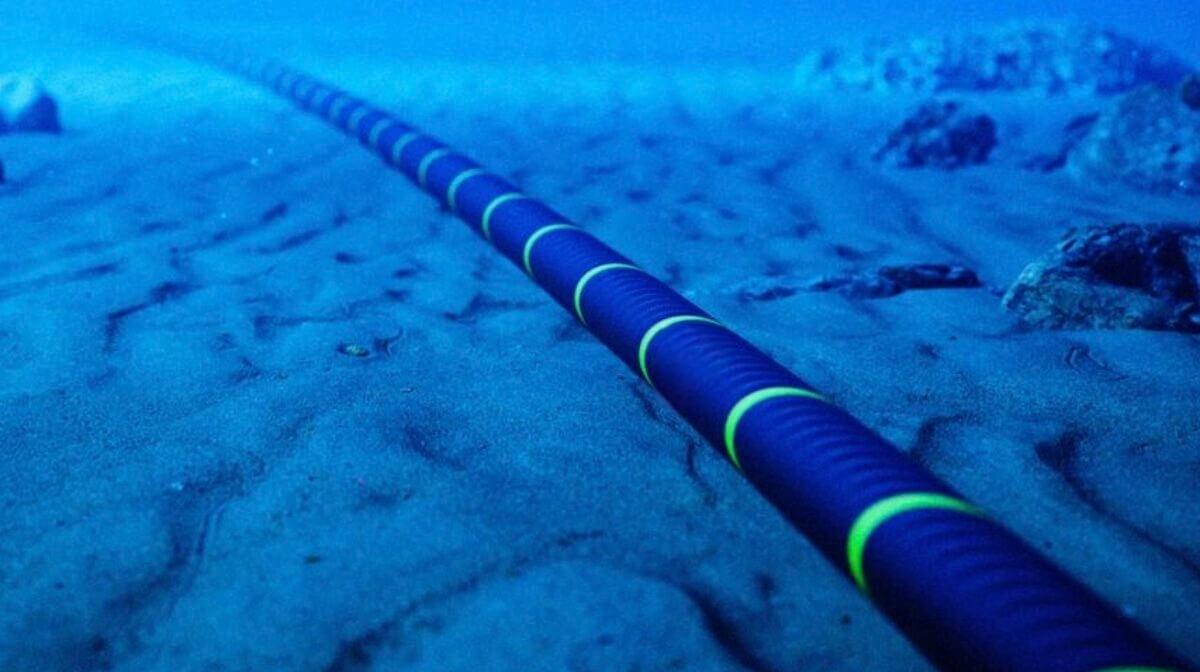
Satellites handle a tiny sliver of global communication — mostly remote locations, maritime, or backup connectivity. The real workhorses are cables, some of them thousands of kilometers long, sitting quietly on the ocean floor, doing the heaviest lifting of the modern internet.
Let’s dig into how this actually works, because once you understand it, you’ll never look at “the cloud” the same way again.
Wait — there are actual cables under the ocean?
Yes. Hundreds of them, in fact. As of the mid-2020s, there are over 500 active and planned submarine cable systems crisscrossing the world’s oceans, totaling more than 1.4 million kilometers of cable — enough to wrap around the Earth roughly 35 times.
These aren’t small wires either, at least not in the way you’d imagine.
A submarine cable is a marvel of engineering: at its core are pairs of hair-thin optical fibers, often no thicker than a strand of human hair, through which data travels as pulses of light. Surrounding that fragile core are multiple layers of protection — copper conductors for power, steel wire armor for strength, and a tough outer polyethylene sheath, all combined to create a cable roughly the diameter of a garden hose in most deep-sea sections (though it gets much thicker near shorelines, where it needs extra armor against fishing trawlers, anchors, and shifting seabeds).
Inside that hose-sized cable, mind you, is the infrastructure carrying a genuinely staggering share of the planet’s financial transactions, video calls, emails, and cat videos.
Why light, and why fiber?
Data on submarine cables travels as pulses of laser light through glass fiber, not as electrical signals through copper.
This is the same fiber optic technology used in high-speed internet connections on land, just scaled up massively and re-engineered to survive the ocean.
Light-based signals can travel enormous distances with far less energy loss compared to electrical signals, and fiber optics can carry vastly more data per second. A single modern submarine cable can carry data at speeds measured in terabits per second — some of the newest cables are designed to handle over 200 terabits per second, enough to transmit the entire printed collection of the U.S. Library of Congress multiple times every second.
Who actually builds these things?
Submarine cables aren’t laid by any single government or company acting alone — they’re usually massive collaborative infrastructure projects, funded by consortium of telecom companies, governments, and increasingly, big tech companies themselves.
That last part often surprises people.
Companies like Google, Meta, Amazon, and Microsoft have become major players in building and owning their own submarine cables, rather than simply leasing capacity from telecom carriers like older internet infrastructure once required.
Google alone has invested in dozens of cable systems worldwide, partly to guarantee reliable, high-speed connections between its own data centers scattered across continents. This also helps them to limit the costs at all levels.
Specialized cable-laying ships — genuinely one of the more unusual and fascinating vessels on the planet — carry enormous coiled reels of cable and slowly lay them across the ocean floor, guided by detailed seabed surveys to avoid underwater mountains, shipping lanes, fishing zones, and known geological hazards like fault lines. Laying a single major cable route can take months and cost hundreds of millions of dollars.
How does a cable actually get to the bottom of the ocean?
The process is more deliberate than simply dropping a giant spool of wire overboard, though the basic idea isn’t far off.
1. Route planning and surveying. Before any cable touches water, engineers spend months (sometimes years) mapping the ocean floor along the proposed route. They’re looking for the safest path — avoiding coral reefs, volcanic zones, deep trenches, and areas with heavy ship traffic or fishing activity.
2. Manufacturing. The cable itself is manufactured in long continuous segments at specialized factories, then coiled into massive tanks aboard cable-laying ships. A single ship can carry thousands of kilometers of cable at once.
3. Laying the cable. As the ship moves along the planned route, the cable is fed out from the stern at a carefully controlled pace. In shallow coastal waters, the cable is often buried beneath the seabed using a plow-like device towed behind the ship, protecting it from anchors, trawling nets, and tidal movement. In deep ocean waters — often several kilometers down — the cable is simply laid directly on the seafloor, since the extreme depth itself provides natural protection from most human activity.
4. Landing stations. Every submarine cable eventually comes ashore at a cable landing station — a secured facility where the undersea cable connects into a country’s terrestrial internet infrastructure. These landing points are chosen carefully and are often clustered in strategic coastal hubs.
5. Repeaters along the way. Because light signals weaken over extremely long distances, cables include repeaters spaced roughly every 50–100 kilometers along their length. These are essentially underwater amplifiers, boosting the optical signal so it can continue its journey without degrading. They’re powered by electricity sent through copper conductors running the entire length of the cable — meaning a cable stretching thousands of kilometers also needs a continuous electrical current running through it from end to end, just to keep those repeaters alive.
What happens when a cable breaks?
Cables do get damaged — more often than you’d think. Ship anchors dragging across the seabed, fishing trawlers, underwater landslides, and even shark bites (yes, really — sharks have been known to bite cables, possibly attracted to the electromagnetic fields) have all caused cable faults over the years. Natural events like underwater earthquakes and volcanic activity can also sever cables entirely, sometimes cutting multiple routes at once.
When a break happens, specialized cable repair ships are dispatched to the location. Using grappling equipment, they locate the damaged section on the ocean floor — sometimes several kilometers deep — haul it up, splice in a new section, test the connection, then carefully lower the repaired cable back down. Depending on depth, weather, and location, repairs can take anywhere from a few days to several weeks.
This is also why redundancy matters so much in how the internet is architected. Because individual cables can and do fail, most regions are connected by multiple independent cable systems along different routes. When one cable is damaged, traffic automatically reroutes through others — usually with only minor slowdowns rather than a total outage. That said, some regions with fewer redundant routes have experienced serious, sometimes days-long internet disruptions following a single major cable fault, which is a reminder of just how physically fragile this invisible backbone can be.
The choke points of the internet.
Not all parts of the ocean are equally cable-dense. Certain narrow geographic corridors act as major choke points where dozens of cables converge because of geography, making them both critical and vulnerable.
The Red Sea, for instance, is a major corridor connecting Europe and Asia, and a huge share of global internet traffic passes through this relatively narrow body of water. Similarly, the waters around Singapore, Egypt, and the English Channel are dense with cable traffic due to their strategic positions along historic global trade and communication routes.
This concentration means that a single incident — a dragged anchor, a geopolitical conflict, or deliberate sabotage — in one of these narrow corridors can potentially disrupt connectivity for entire regions simultaneously.
It’s one of the reasons submarine cable security has become an increasingly serious topic in international policy and defense circles in recent years.
Why not just use satellites?
This is the natural question, especially with the rise of satellite internet constellations. But satellites and submarine cables solve different problems.
Submarine cables offer dramatically higher bandwidth and much lower latency for long-distance data transfer compared to satellites. A signal traveling through a well-maintained fiber cable moves at close to two-thirds the speed of light through glass, with consistent, predictable latency. Satellite signals — especially those from traditional geostationary satellites — have to travel tens of thousands of kilometers up and back down, adding noticeable delay.
Newer low-earth-orbit satellite constellations have narrowed this latency gap significantly and are excellent for reaching remote or underserved areas where laying cable isn’t practical. But in terms of raw capacity — the sheer volume of data that can move between major global hubs — nothing currently rivals fiber optic submarine cables. Satellites complement the system; they don’t replace it.
A system most people never think about.
What makes submarine cables so fascinating is how invisible they are to the billions of people who rely on them every single day. Nobody thinks about undersea infrastructure while sending a WhatsApp message or joining a Zoom call — and in some sense, that’s exactly the point. Good infrastructure is infrastructure you never have to think about.
But underneath that invisibility is an extraordinary amount of physical engineering: ships slowly laying cable across ocean floors, repeaters silently amplifying signals in complete darkness kilometers underwater, and repair crews occasionally racing against time to fix a break before it disrupts an entire region’s connectivity.
The next time your video call loads instantly, or a website halfway across the world responds in a fraction of a second, remember what’s actually making that possible — not some abstract cloud floating overhead, but real, physical cables lying quietly on the ocean floor, carrying the pulses of light that keep the modern world connected.
Final thoughts.
Submarine cables are one of the great unsung achievements of modern engineering — a global nervous system running silently beneath the waves, largely unnoticed by the people who depend on it most. They’re a reminder that even our most digital, seemingly weightless technologies are ultimately built on very physical, very tangible foundations.
So the next time someone mentions “the cloud,” you can smile a little, knowing the truth: it’s mostly cables, sitting quietly at the bottom of the ocean, doing the real work.

Leave a Reply